
I was in California this summer to dodge the heat and humidity of Northern Virginia, and while there, I was able to learn a lot about energy infrastructure on the West Coast. I also took a class on the basics of energy storage and integration, where I was introduced to one of the main issues our modern world faces on every scale: energy scarcity. The truth is, we have the technological capability to replace much of our energy generation with renewables; many of the remaining challenges are logistical. Simply put, energy is expensive to produce, transport, and store, which is why energy storage is so important. Installing batteries, however, can cost tens of thousands of dollars, a price tag that may seem outrageous to many. Thus, I was intrigued to learn about a potentially revolutionary—and surprisingly feasible—solution: using electric vehicles and the batteries already contained within them.
To understand why this may be useful, we must begin with the difference between power and energy. Energy is the total amount of work that can be done or the amount of electricity that can be stored in a battery, typically measured in watt-hours (Wh), kilowatt-hours (kWh), megawatt-hours (MWh), or joules (J). Power, on the other hand, is the rate at which energy is generated, transferred, or supplied, typically measured in watts (W), kilowatts (kW), or megawatts (MW). For example, a 100 kWh battery could theoretically discharge at 10 kW for 10 hours, 1 kW for 100 hours, or 100 kW for one hour, depending on its power rating.
Got it?
This distinction is important when installing solar panels (henceforth referred to as solar PV). If your goal is to close a 15 kW power gap, simply installing 15 kW of solar PV may not be enough. That 15 kW rating describes the maximum power the system can produce under certain conditions, but because of variables such as panel orientation, weather, and time of day, that maximum will not always be reached. What’s more, solar panels alone cannot always achieve their full potential. Since solar production is generally highest around midday, while electricity demand often spikes in the evening, excess solar energy may go unused without a way to store it. Therein lies the problem: batteries can cost a lot of money, and not everyone can afford them.
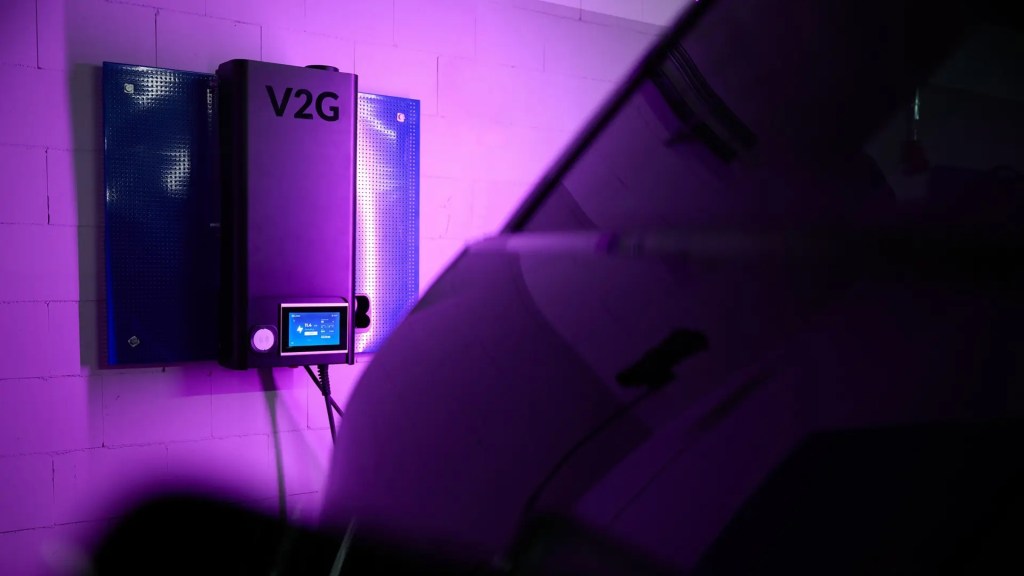
This is where the subject of this article comes in: vehicle-to-grid (V2G) technology. In short, V2G allows the electrical grid to use electric vehicles—and their batteries—to store and discharge energy. During periods of peak demand, such as in the evening, electricity discharged from EV batteries could help “shave” those peaks, reducing stress on the grid. Excess energy generated by solar PV could also be stored in the cars instead of going unused. A vehicle owner could then be compensated for participating, generating passive revenue based on how much energy their car provides to the grid.
There are still many issues with V2G, however.
Using just one vehicle would not have much of an effect on the grid, which is why V2G systems may rely on aggregators. Aggregators coordinate hundreds, thousands, or potentially even millions of EVs so that they can collectively function as a Virtual Power Plant (VPP), using the resources under their control to help stabilize and support the grid. Aggregators can ensure that no single vehicle is used excessively and that each vehicle maintains a sufficient state of charge. This way, even while contributing to the grid as part of a larger system, the cars can still serve their original purpose: getting their owners where they need to go.
In addition, regularly cycling a battery—discharging and then recharging it—leads to battery degradation over time, and EV batteries are no exception. The additional deterioration caused by V2G use, though incremental, could potentially outweigh the economic benefits of energy compensation for some vehicle owners if it significantly shortens the battery’s useful lifespan.
V2G also requires bidirectional charging equipment, which is more complicated and expensive than conventional charging equipment. In addition, many EVs currently lack the hardware or software necessary to support V2G.
Still, with further development and large-scale implementation, V2G could become a surprisingly feasible and widespread part of the solution to our energy challenges. It is already being tested and implemented in certain locations around the world, and as more electric vehicles enter the market, the technology’s potential continues to grow. After all, we live in an age in which we are increasingly concerned about the scarcity of our resources, so why not be resourceful with the ones we already have?
As I once read in the comments section of a YouTube video, “If God wanted us to have infinite energy, he would’ve put a giant nuclear reactor in the sky.”
We have pretty much everything we need to power the world sustainably. We just have to figure out how to use it.




Leave a Reply